SL-PAb001 / ALLERGEN RESEARCH

Art v 1Mouse polyclonal antibody

For detecting and analysing the mugwort pollen allergen Art v 1 in research applications.

Download product datasheet (PDF)

For research use only. Not for diagnostic or therapeutic use.

01 / OVERVIEW

An antibody for
Art v 1 research

SL-PAb001 is a mouse polyclonal antibody raised against recombinant Art v 1. It is used in Western blot (WB) analysis of recombinant Art v 1 protein and Artemisia vulgaris pollen extract for allergen research.

The pollen-extract experiment uses Artemisia vulgaris. Suitability for other Artemisia species requires independent validation.

Evaluate ELISA suitability and performance with the intended samples and experimental conditions.

02 / EXPERIMENTAL RESULTS

Western blot
results

Western blot results for recombinant proteins and extracts. Open an image for a closer view.

WB / 01

Detection of His-tagged recombinant Art v 1

His-tagged recombinant Art v 1 is detected by Western blot using a His-tag monoclonal antibody (left) and SL-PAb001 (right).

Result interpretation and scope

The panels show band signals and are not a quantitative comparison of detection limits or relative sensitivity.
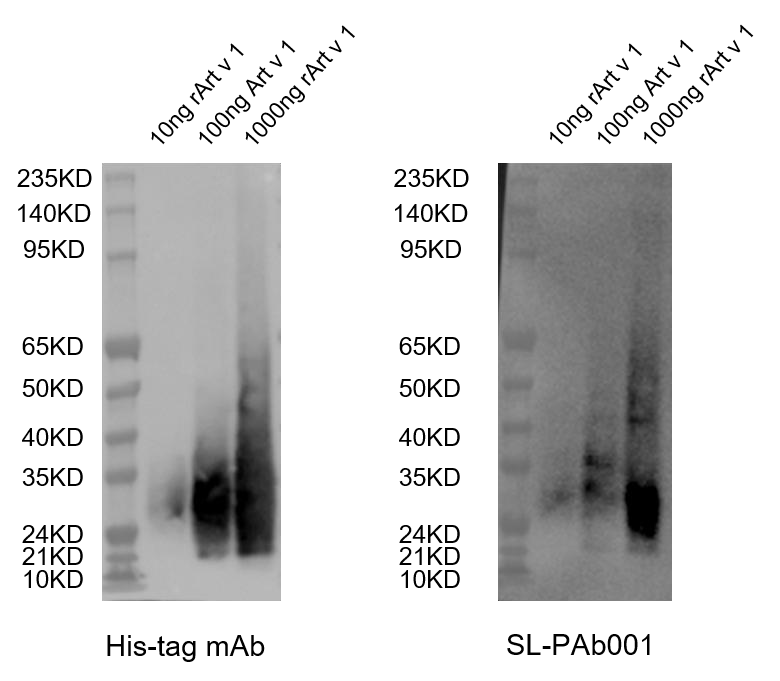
Western blots of recombinant Art v 1: His-tag mAb on the left and SL-PAb001 on the right, each with 10, 100 and 1000 ng loading lanes and molecular weight markers.Enlarge image
Figure 1 | Left: His-tag mAb. Right: SL-PAb001. Recombinant Art v 1 loading is 10, 100 and 1000 ng in each panel.

WB / 02

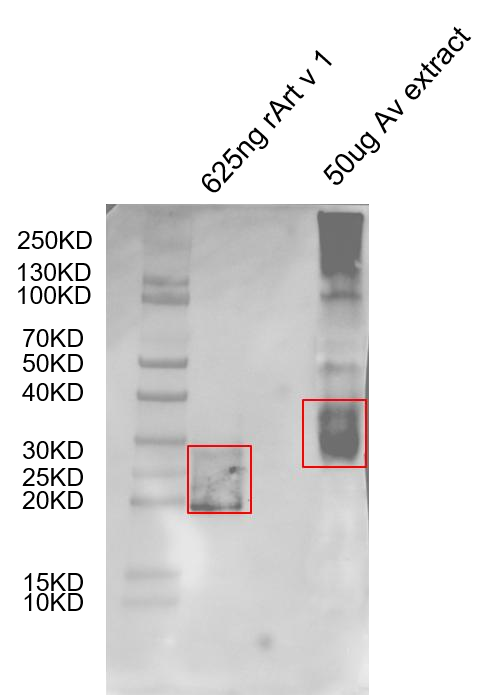
Recombinant protein and pollen extract

SL-PAb001 is used to detect recombinant Art v 1 and Artemisia vulgaris pollen extract (Av extract). Sample identities and loading amounts are shown in the figure and caption.

Result interpretation and scope

Recombinant protein and extract differ in loading amount and sample composition. This image is not a comparison of antigen abundance or detection efficiency.

SL-PAb001 Western blot with molecular weight markers, 625 ng recombinant Art v 1 and 50 µg Artemisia vulgaris pollen extract; red boxes are visible in the image.Enlarge image
Figure 2 | Recombinant Art v 1: 625 ng. Av pollen extract: 50 µg. Molecular weight markers and sample lanes are labelled in the image.

Result scope: these WB results relate to the samples and conditions shown. Other samples and applications require independent validation. Images do not quantify affinity, purity or clinical effects.

Discuss assay suitability & collaboration

03 / SPECIFICATIONS

Specifications
& conditions

Use the recommended dilutions as starting points for optimization. Select working conditions for your samples and assay setup.

Catalog number
SL-PAb001
Antibody type
Mouse polyclonal antibody
Immunogen
Recombinant Art v 1 protein from Artemisia vulgaris
Immunogen GenBank accession
AAO24900.1
Reactive species
Artemisia vulgaris, Artemisia annua, Artemisia sieversiana
Applications
ELISA, Western blot (WB)
Recommended dilution
1:1000–1:5000 (ELISA / WB; optimize for the specific experiment)
Formulation
PBS with 1% BSA; preservative-free
Storage
−20°C to −80°C; avoid repeated freeze–thaw cycles
Storage stability
12 months from the date of receipt under the stated storage conditions
Intended use
For research use only. Not for diagnostic or therapeutic use.

04 / APPLICATIONS & USE

Application & handling guidance

Application suitability

Plan research applications using ELISA or WB, with appropriate validation for each method and sample type.

Optimize for the experiment

Use the recommended 1:1000–1:5000 dilution range as a starting point, then evaluate suitability with the intended samples, assay setup and controls.

Storage and research use

Store at −20°C to −80°C and avoid repeated freeze–thaw cycles. Under these conditions, the storage stability is 12 months from receipt. For research use only, not diagnosis or treatment.

05 / COLLABORATION

Discuss antibody applications
& collaboration

Tell us your research goal, sample types and intended methods. For bulk or distribution enquiries, include your estimated requirements and collaboration interests.

  • Research evaluation and application suitability
  • Experimental validation and assay optimization
  • Bulk requirements and distribution discussions

Feasibility, materials and collaboration terms are discussed for the individual project.

Contact Cellpeutics